


Published on
Amjad Ghanim revealed a plan to collect 20,000 human genome samples by the end of the year and to expand the Genome Center for local analysis.
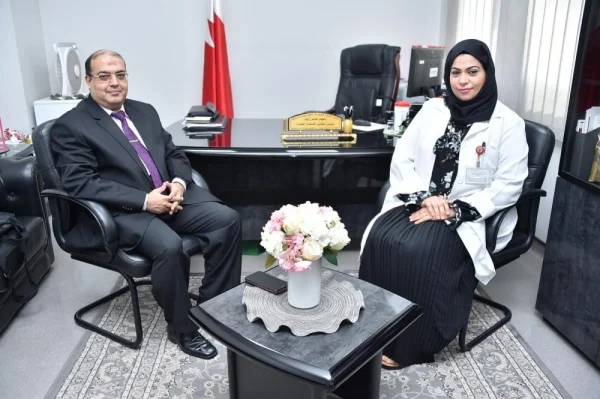
The head of the implementation team for the genome analysis project plan, supervisor of the National Genome Center project, and head of public health laboratories, Amjad Ghanim, revealed that "among the center's strategic plans is to collect the largest possible number of samples from the Bahraini community, genetically classify them, and identify genetic mutations that may be linked to certain chronic and hereditary diseases, as well as to train Bahraini cadres of doctors and technicians to work on this project," adding that "it is expected that 20,000 'human genome' samples will be collected by the end of this year." She noted that "the Genome Center is currently being expanded to conduct studies locally without relying on external parties, and thus we will soon develop local cadres for genome analysis in Bahrain."
In an interview exclusive to "Alwatan News," she added that "6,000 genome samples for the coronavirus (COVID-19) have been analyzed, including 4,000 domestically at a rate of 60%, and 2,000 abroad at a rate of 40%," pointing to "the expansion of the National Genome Center within the Public Health Directorate at the Ministry of Health."
She stated that "among the center's objectives are identifying common and rare hereditary diseases among members of the Bahraini community for study, revealing an individual's genetic makeup to improve treatment methods, and establishing a reference information system and an integrated genetic database for the Bahraini community that contributes to determining the prevalence of hereditary diseases among segments of society in order to limit their spread to future generations," indicating that "the National Genome Center is currently studying 16 rare diseases in Bahrain."
Amjad Ghanim spoke about "the existence of cooperation and coordination with Harvard University to prepare a preliminary study on the genetic variations present in the Bahraini community, to understand the genetic causes of various hereditary diseases, and to expand the capacity of the National Genome Center by providing the latest high-quality technologies, training Bahraini cadres through prestigious institutions in this field, and establishing a biobank for Bahrain." The following are more details from the interview:
Could you give us a brief overview of the National Genome Center?
Stemming from the government's keenness to raise the quality of health services and prevent diseases—especially hereditary, intractable, and deadly diseases—and in line with the latest innovative scientific methods, the idea of establishing a specialized center for gene analysis was born. The Ministry of Health took the necessary steps and measures to establish the center. This national project aims to provide opportunities for a better, healthier life for future generations, and to improve treatment prospects, raise the quality of health services, and prevent diseases for current generations, by providing a DNA database for the Bahraini people. Reading and analyzing this data contributes significantly to improving disease diagnosis and early detection, as well as determining individuals' susceptibility to them. It also contributes to preventing hereditary diseases and developing effective medications to treat them, which helps provide a healthy life and disease prevention for current and future generations, and elevates the status of our precious Kingdom.
Could you give us a brief overview of the genome?
The genome is the complete set of genetic information present in DNA, containing 20,000 to 25,000 inherited genes located in the cell nucleus, arranged in 23 pairs of chromosomes. The human body contains billions of cells, which form the basic structure of all body organs, and each cell contains a nucleus. Inside the nucleus lies a complete record of all the hereditary traits encoded for that individual; this record is scientifically referred to as the "genome." The Bahrain Genome Project aims to study the genetic makeup of Bahrain's population in order to learn more about the genetic factors that make Bahrain's residents susceptible to certain diseases. The project will also contribute to developing diagnostic methods and medications tailored to each individual's genetic makeup, in what is known as personalized medicine.
Could we discuss the purpose behind establishing the center?
The objectives of establishing the center are as follows:
- Identifying common and rare hereditary diseases among members of the Bahraini community for study.
- Analyzing samples from the Bahraini community according to the highest international standards in this field.
- Qualifying and training national Bahraini cadres in the field of genetic classification and genetic data analysis.
- Conducting genetic classification to detect the genetic predisposition of an individual and their family, in order to identify the variants causing hereditary diseases and the likelihood of their occurrence.
- Revealing an individual's genetic makeup to improve treatment methods and determine the response to and dosage of various medications.
- Establishing a reference information system and an integrated genetic database for the Bahraini community that contributes to determining the prevalence of hereditary diseases among segments of society in order to limit their spread to future generations.
- Preparing and publishing research related to genetic patterns in the Kingdom of Bahrain to contribute to the global database concerned with developing genetic treatments.
What about the center's upcoming strategic plan for this year?
Collecting the largest possible number of samples from the Bahraini community, genetically classifying them, and identifying genetic mutations that may be linked to certain chronic and hereditary diseases, along with training Bahraini cadres of doctors and technicians to work on this project. The Genome Center is currently being expanded to conduct studies locally, without relying on external parties—what we call "in-house"—in order to strengthen local testing capabilities and achieve self-reliance in analyzing samples in Bahrain. Accordingly, we will develop local cadres for genome analysis in Bahrain, while simultaneously drawing on external expertise from institutions with a long track record in this field, such as Harvard University. We must also mention the unlimited support from the government for this project, as we have received logistical and moral support, as well as external training, despite the circumstances of COVID-19, with the team undergoing training even via video conferencing.
What are the most notable achievements of the center since its opening in 2019?
So far, 9,000 human genome samples have been collected, and it is hoped that 20,000 "human genome" samples will be collected by the end of this year. Work is also underway to strengthen national cadres for human genome analysis locally in the near future. It should be noted that at the outset, a number of tasks were accomplished, namely completing the target number for the first phase of the project, which was 6,000 samples, including 2,000 samples from patients with rare diseases and their relatives, and another 4,000 samples from other participants. Several studies related to the COVID-19 genome and the genomes of infected patients were also supervised, in order to identify the genes related to the severity of infection.
Cooperation and coordination are also taking place with Harvard University to prepare a preliminary study on the genetic variations present in Bahraini society, to identify the genetic causes of various hereditary diseases, and to expand the capacity of the National Genome Center. This is being achieved by providing the latest high-quality technologies, training Bahraini cadres through prestigious institutions in this field, and establishing a biobank for Bahrain.
How many samples is the center aiming to collect, both for rare disease sequencing and for general population sequencing?
The center aims to collect 50,000 human genome samples over 5 years, at a rate of 10,000 samples per year.
What is new regarding the analysis of the COVID-19 genome?
4,000 genome analyses of the COVID-19 virus have been completed locally, and 2,000 externally, bringing the total number of COVID-19 genome samples analyzed both domestically and abroad to 6,000.
Could you tell us about the Genome Laboratory and its departments?
The Genome Laboratory is divided into 3 main departments:
- The Biobank Department.
- The Genetic Classification Department.
- The Bioinformatics Analysis and Genetic Mutation Identification Department.
What is a biobank?
A biobank is a scientifically qualified facility for storing biological samples, such as DNA and tissues, for the purpose of future study. It thus serves as a repository for storing samples from the body, whether tissue samples, bone marrow, blood, or others, in addition to demographic and clinical information. The biobank was established at the Salmaniya Medical Complex, affiliated with the Ministry of Health, to become a leading center in the region in providing an interactive platform for supplying the samples needed to conduct studies and research. It is worth noting that the National Genome Center at the Public Health Directorate of the Ministry of Health is currently being expanded.
What about the Genetic Classification Department?
Genetic classification is carried out according to internationally recognized classifications, using specialized programs that enable us to determine the genetic type. This is essentially the process of genetic sequencing within the devices, and it is a department and laboratory dedicated to analyzing and classifying genes.
And what about the Bioinformatics Analysis and Genetic Mutation Identification Department?
Through this department, we are able to obtain information produced by the devices, which may be ambiguous or unfamiliar to the average person. These are genetic sequences that we input into specialized programs connected to vast databases through analysis and classification software. The analysis is then carried out within these programs, yielding the genetic classification—for example, blue eye color. Each program specializes in a specific area; for instance, we can detect a particular disease, the extent of genetic predisposition to it, and the appropriate treatment for it. In short, these are specialized programs for analyzing the information produced by the devices after genetic classification.
Has the required number of samples for the Bahrain Genome Project been fully collected?
The collection of required samples has begun, and the remaining samples are being gathered in accordance with the timeline set for this project.
Does the project involve both citizens and residents, or citizens only?
The project is limited to citizens in its initial phases, and may later include residents in line with the project's vision and strategic plan.
How can those interested undergo testing? Are there designated blood sample collection points? Where will this take place?
Through accredited testing centers, which will be announced soon by the project implementation team on official websites and social media platforms.
Can volunteers participate in the project?
Yes, participation in this program is voluntary. A volunteer campaign has been launched at health centers, covering all Bahrainis who wish to take part in this study related to the Bahrain Genome. There is no age restriction, in order to attract participants from all age groups.
Is it planned to include newborns in the project? How will this be done, and what percentage do they represent compared to the total number?
The mechanism for including newborns in the project will be studied during its advanced stages, while children from the age of 3 are allowed to participate, provided that parental consent is obtained in accordance with the laws and regulations of the Kingdom of Bahrain.
What are the most notable areas of cooperation and agreements signed between the center and international universities?
The Kingdom is keen to cooperate with institutions possessing advanced expertise in the field of genetic diagnosis and treatment, in order to achieve a better and healthier life for citizens and residents. Cooperation and coordination have been established with Harvard University to prepare a preliminary study on the genetic variations present in Bahraini society and to identify the genetic causes of various hereditary diseases.